




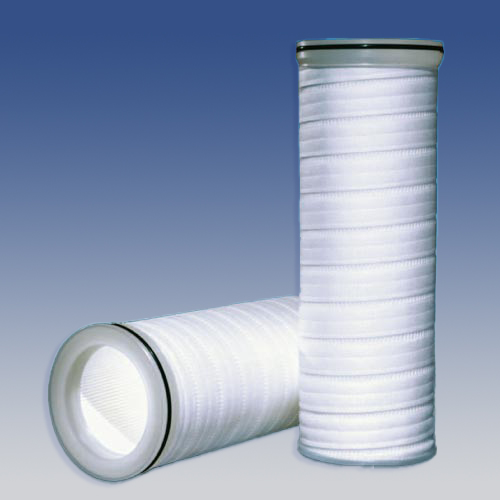
SepraSol™ Liquid/Gas Coalescer
Clean, aerosol free gas is critical to equipment reliability and the economic efficiency of gas processing, petroleum refining and chemical processing. Pall's SepraSol™ Liquid/Gas Coalescer product line contains a patented hydrophobic/ oleophobic treatment which provides maximum liquid and solid removal efficiency at a low saturated pressure drop to reduce the maintenance and operating costs associated with the use of contaminated gas.
Pall's high efficiency SepraSol coalescer is recommended for a wide range of gas filtration applications, such as:
- Protecting compressors and turbines.
- Removing lubrication oil, water, compressor wear products, corrosion products and other dirt from effluent gas streams.
- Minimizing foaming tendencies upstream of sweetening and dehydration units.
- Minimizing amine and glycol losses downstream of gas sweetening and dehydration units.
- Protecting combustion equipment by cleaning fuel gas.
- Cleaning dirty fuel gas and instrument gas.
- Controlling injection well plugging during gas flooding.
- Protecting catalysts, desiccants and absorbants.
- Removing lube oil from ammonia gas.
Coalescer Technical Information
Oleophobic/Hydrophobic Treatment – All of Pall's liquid/gas coalescers receive Pall's patented oleophobic/hydrophobic treatment. Chemically treating the coalescer lowers the surface energy of the medium and promotes rapid drainage of the coalesced liquids. This significantly increases the amount of liquid per unit area of medium the coalescer can handle. Added benefits to the chemical treatment include lower saturated pressure drop, which saves operating costs and rapid recovery from liquid slugs.
Cylinder Shaped Coalescer – The optimal coalescer shape is a cylinder. The pleat spacing in a cylinder allows for equal flow distribution throughout the length of the cartridge. In other shaped coalescers, like a cone, the spacing is typically tighter at the top than at the bottom.
In the case of the conical shape, the flow is forced preferentially through the path of least resistance at the bottom of the cartridge. This prevents full utilization of the medium, increasing the number of coalescer cartridges required to efficiently remove liquids.
Features, Advantages and Benefits of the Pall SepraSol Liquid/Gas Coalescer
Pall's SepraSol™ liquid/gas coalescers eliminate virtually all solids and liquids in a gas stream. Downstream liquid levels are as low as 0.003 ppmw* and solids removal rating is 0.3 µm (99.99% efficiency.**)
| Features | Advantages | Benefits |
|---|---|---|
| High Capacity Large Diameter Element | - Fewer elements needed for a given gas flow rate. - Minimized vessel diameter. |
- Reduced capital and installation costs. - Smaller space required for installation. |
| Patented Oleophobic/ Hydrophobic Media Treatment | - Quicker liquid drainage. - Lower saturated pressure drop. - Quicker recovery from liquid slugs. - Minimized vessel diameter due to less restrictions on annular velocity. |
- Reduced capital and operating cost. - Improved product quality and consistency. |
| High Effective Filtration Area | - Fewer element changeouts needed. - High solids removal efficiency. |
- Lower operating and maintenance costs. |
| High Efficiency Media and Draining Materials | - Consistently high liquid removal efficiency. - Reduced liquid losses. - Optimum protection of downstream equipment. |
- Lower maintenance costs and improved availability. |
*Test conditions used to measure efficiency area as follows: Flow rate: 900 SCF/minute per 30" element at 100°F and 100 psig. Liquid inlet: 50 ppmw oil
**Per sodium chloride test
Features of the Pall SepraSol Liquid/Gas Coalescing Filter
Pall coalescing filter cartridges operate economically with high separation efficiency, and long life.

| Performance Specification Solid Removal Rating 0.3 µm (99.99%) | |
|---|---|
| Solid Removal Rating | 0.3 µm (99.99%) |
| Temperature Rating | 180°F (82°C) 150°F (65°C) with Water |
| Clean & Saturated Pressure Drop | sized to your specification |
Effect of Pressure Drop on Compressor Operating Costs*

*Conditions: Delta P on inlet pressure
Inlet Pressure = 20 psia
Outlet Pressure = 200 psia
Gas compressed is methane C
Costs based on $0.07/kwhr
Pall’s patented oleophobic/hydrophobic chemical treatment of all of its SepraSol liquid/gas coalescers allows the coalescers to operate at a lower saturated pressure drop. As shown on Figure 1, a small difference saturated pressure drop can result in significant savings in operating
About Coalescer Efficiency Ratings
The measurement of the efficiency and the pressure drop of a coalescer should reflect operating conditions. Many manufacturers of coalescers measure efficiency using the dioctyl phthalate (DOP) test. The DOP test was not originally designed to measure the performance of a coalescer under operating conditions seen in the oil and gas industry. Rather, the DOP test is performed under the following conditions:
- Measures only capture efficiency and does not indicate how much liquid is at the filter outlet. It is the outlet concentration, which will indicate whether downstream equipment and processes are vulnerable to damage.
- Measures only the percent removal of DOP aerosols that are 0.3 µm compared to a range of sizes normally seen in oil and gas applications.
- Measures the removal of DOP, a liquid not typically found in oil and gas applications.
- Performed under a vacuum, not typical of operating conditions.
- Performed on a dry coalescing element; the effectiveness of a coalescer should be measured when a coalescer is completely saturated.
Pall has developed a test called the Liquid Aerosol Separation Efficiency (LASE) Test to specially measure the performance of a coalescer under operating conditions. Table 1 compares the LASE and DOP test. For further details on the LASE test, see Pall literature GAS-4300b, "Recent Developments in Performance Ratings of Gas/Liquid Coalescers."
Table 1: Pall LASE Test vs. Conventional DOP
| Pall LASE Test | DOP Test | LASE Advantage | |
|---|---|---|---|
| Efficiency Rating | Measures ppmw of total downstream aerosol concentration | Measures only the capture efficiency of 0.3 µm DOP aerosols | Specifies performance based on total liquid removal |
| Test Contaminant | Polydispersed 20 wt. compressor lube oil (size range 0.1-1.0 µm) | Monodispersed dioctyl phthalate (size range at 0.3 µm only) | Closely simulates actual process contamination |
| Downstream Contaminant Measurement | Full flow membrane sampling of all size contaminants | Indirect light scattering of 0.3 µm contaminants | Directly measures the amount of all liquid downstream |
| Pressure Conditions | Performed under positive pressure | Performed under vacuum | More closely reflects actual process pressure conditions |
| Cartridge Condition | Performed on a saturated cartridge | Performed on dry cartridge | Reflects actual process cartridge service conditions |
| Pressure Drop Measurement | Measures operating saturated cartridge pressure drop | Measures dry cartridge pressure drop | Provides a more realistic service pressure drop |
Nominal Cartridge Dimensions
| Part Number | Outer Diameter | Length | Surface Area |
|---|---|---|---|
| CC3LGA7H13* | 2.75" (70 mm) | 30" (762 mm) | 9.5 ft.2 (0.88 m2) |
| CC3LGB7H13** | 2.75" (70 mm) | 30" (762 mm) | 9.5 ft.2 (0.88 m2) |


