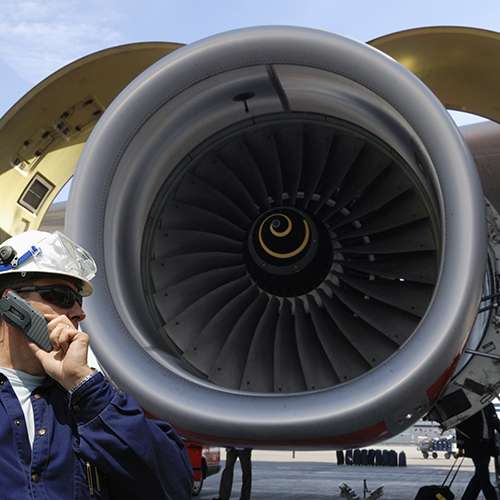



The Centrisep EAPS is an all-weather, self-cleaning, fit-and-forget filtration system that protects helicopter engines against contaminants. It uses vortex separators to provide engine protection by continuously scavenging the contaminants from inlet air and expelling them overboard. This process minimizes unscheduled engine removals, keeping labor and associated costs down. It also results in greater engine reliability, increased operational availability, enhanced performance, and safer operation.
For further questions, queries, and comments, please contact us.
During the development of the RTM322 engine for the NH90, Merlin, and Apache helicopters, Turbomeca evaluated a Centrisep EAPS unit against the IPS system. They investigated the best system for protecting the engine's first compressor wheel, which is the one most prone to erosion. According to the Turbomeca report1: "Research has confirmed that engines protected by Vortex Separators have longer overhaul lives than those with a conventional IPS."
The engine life increase with a vortex separator compared to an IPS was two to five times, depending on the test dust used. Based on this testing, the Centrisep EAPS is the standard option on the NH90 helicopter.
Top
No. Pall has tested the Centrisep EAPS with dust concentrations of up to five grams per cubic meter of air, proving that the efficiency remains constant. (Such a high dust concentration simply does not exist in real helicopter operation). During desert operations in Namibia, dust concentrations of up to 2.5 grams per cubic meter of air have been recorded, but this was with a Puma helicopter, hovering in ground effect, for twenty minutes! So the Centrisep EAPS remains fully operational in these extreme conditions.
Defence Standard 00-34 Part 4 published by the UK Ministry of Defence defines a dust concentration of 2 g/m3 as "representative of the most arduous conditions associated with aircraft, particularly helicopters, operations."
Note: The manufacturers of oil wetted IBFs advise the following "When operating in an environment of high sand and dust levels, frequent servicing of the filter assembly may be required based on the time exposure and severity of the environment. Any operations in an environment that can result in "brownout" conditions should therefore be minimized or avoided to the maximum extent possible within the constraints of the operation."
Top
Power penalties vary considerably from one helicopter to another. On some helicopters, Centrisep EAPSs actually increase the amount of available power for the helicopter. This is due to the fact that the air flow and pressure distribution at the compressor entry plane is improved compared to basic helicopter engine intakes. On other helicopters, the power penalty resulting from the pressure drop and the scavenge system can be fairly high because of installation constraints. However, the penalty is still small when compared to the power loss due to early engine erosion and the pressure drop is constant so the pilot knows what performance to expect. In contrast to basic helicopter intake systems, the loss of power typically cannot be detected in hover on the latest 'state-of-the-art' Centrisep designs. The penalty may be more noticeable in forward flight, perhaps resulting in a slight increase in fuel consumption.
Top
The turbine outlet temperature (TOT) is proportional to pressure drop (DP). Every filter system has a pressure drop (DP). Some are constant, some are variable. Centrisep EAPS designs have a constant DP so the pilot knows what performance to expect. In contrast, barrier filters have a variable DP. The pressure drop increases as the filter becomes blocked and hence the TOT increases.
Top
The scavenge system, whether it involves P2 air activated ejectors or electrical fans, must be ON for the Centrisep EAPS to be efficient. This means that it is extremely important that the scavenge system is energized before the helicopter encounters dusty conditions. If activated too late, the efficiency of the system drops dramatically.
In desert environments, dust can be encountered at extremely high altitudes. In these conditions, we recommend that the scavenge system be on at all times.
Scavenge is also required under heavy rain, as a fair proportion of the rain can be separated by the Centrisep EAPS to prevent engine flame out.
Scavenge is required at all times in a marine environment. A good amount of the salt can be separated to prevent engine fouling in flight and the resulting loss of power.
It should be noted that ice and snow are arrested before they get into the vortex tube, so the scavenge fan is not required in these conditions.
Top
A: Although the Centrisep EAPS removes a fair proportion of the salt, daily flushing of the engine after marine operation is still desirable. To facilitate flushing operations, some of our Centrisep EAPSs feature built-in engine-wash connectors.
Top
No, the air flow is better with the Centrisep EAPS. The swirling motion of the vortex tubes results in uniform, stable air flow into the engine intake. This minimizes any detrimental effects of hot gas ingestion (HGI) - link to HGI page.
Top