




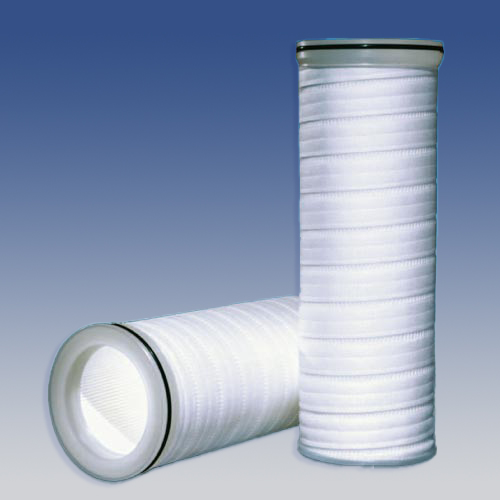
Profile® A/S Series filters are constructed of an all polyphenylene sulfide (PPS) filter medium with 316 L stainless steel cores as standard. The elements have an absolute rated downstream section, and a continuously profiled pore size upstream section, which increases service life many-fold. Note the photomicrograph below. The elements are available in a broad range of absolute removal ratings.
The fibers in Profile A/S filters are continuous, for practical purposes. No binder resin or surfactants are used and the fibers are “bonded” by intertwining during the manufacturing process. The filter components meet the specifications for biological tests listed in the current revision of USP for Class VI plastics at 121 °C. Because of the inertness of the polyphenylene sulfide medium, Profile A/S elements can be used with many fluids up to 400° F (205 °C).
The Profile A/S filter has numerous applications in a broad range of industries that include chemical and petrochemical industries. Typical applications include:
- Amine
- Hot Water
- Glycol
- Sulfolane
- Condensate
- Methylene Chloride
- Naphtha
- Potassium Hydroxide
- Oxo Alcohols
Photomicrograph - Profile Filter Technology
Profile A/S element construction.
- Continuously profiled pore size upstream section.
- Absolute rated constant pore downstream section. Note the continuously decreasing fiber diameter in the profiled upstream section and the constant fiber diameter in the downstream section.
Profile A/S Cartridge Grades and Characteristics
|
| 050 |
<14 |
2.5 |
4.0 |
5.0 |
1.70 |
30.8 |
3-8 |
11-30 |
| 100 |
6 |
8 |
9 |
10 |
0.35 |
6.37 |
6-15 |
23-57 |
| 200 |
11 |
15 |
18 |
20 |
0.10 |
1.82 |
10-15 |
38-57 |
| 400 |
15 |
20 |
30 |
40 |
0.09 |
1.64 |
10-15 |
38-57 |
| 700 |
20 |
30 |
50 |
0.03 |
0.03 |
0.55 |
10-15 |
38-57 |
|
The Profile A/S Series filter elements are aligned within Pall Profile II housings by installing the elements onto a tie-rod. The elements are then secured in place by a seal nut. When fully engaged, the tie-rod/seal nut assembly forms a knife edge sealing surface embedded into the filter medium at both the top and bottom of the element. The elements are secured in alternative housings by spring engaged sealing surfaces.
Profile A/S Filters Compatibility Data with Fluids at 200°F (93°C)
|
| Inorganic Acid |
Hydrochloric, Dilute Nitric, Dilute Sulfuric |
Not Recommended |
| Boric, Phosphoric |
Generally Recommended |
| Organic Acids |
Acetic |
Generally Recommended |
| Formic |
Evaluate on an Individual Basis |
| Bases (Alkalis) |
Sodium Hydroxide, Potassium Hydroxide, Amines, Quaternary Ammonium Hydroxide |
Generally Recommended |
| Salt Solutions |
Aluminum Chloride, Sodium Sulfide, Sodium Nitrate |
Evaluate on an Individual Basis |
| Brines |
Sodium Chloride, Potassium Chloride, Sodium Bromide, Calcium Chloride |
Generally Recommended |
| Aqueous Halogenated Solutions |
Not Recommended |
| Oxidizers |
Peroxides, Peracids |
Not Recommended |
| Organic Solvents |
Ethers, Esters, Amides, Ketones |
Generally Recommended |
| Alcohols, Cellsolves, Glycols |
Generally Recommended |
| Aromatics (Benzene, Toulenes, Xylenes) |
Evaluate on an Individual Basis |
| Petroleum Products (Gasoline, Kerosene) |
Generally Recommended |
| Hydrocarbons (Hexane, Octane, Fats, Oils, Petroleum Ether) |
Generally Recommended |
| Halogenated Hydrocarbons (Methylene Chloride, Perchloroethylene) |
Evaluate on an Individual Basis |
| Water |
Generally Recommended |
| Air |
Generally Recommended |
| Recommended temperature for most organic fluids, unless evaluated on an individual basis |
200 °F/93 °C |
| Maximum temperature limits for compatible fluids |
400 °F/205 °C |
|
Depending on the fluid compatibility, Pall Profile A/S elements may be used at temperatures up to 400°F (205°C). Please contact Pall Corporation for guidance.
Disclaimer: The compatibility data represented in this chart is for general guidance only at the temperature noted. Because so many factors can affect the chemical resistance of a given product, you should pre-test under your own operating conditions observing applicable safety practices such as those given on the Material Safety Data Sheet for each chemical. If any doubt exists about specific applications, please contact Pall Corporation.
Operating Characteristics
- The recommended maximum differential pressure for the standard Profile A/S Series filters is 30 psid / 2 bard up to 400 °F/(205 °C) and 40 psid / 2.8 bard up to 200 °F/(93 °C)
Sizes
- Profile A/S Series filter elements are 21⁄2 in. O.D. and are available in one-piece 93⁄4 in., 10 in., 20 in., 30 in., and 40 in. length modules
Housings for Profile A/S Elements
- Pall offers a full line of filter housings. Please contact Pall for more information.
1The test procedure used for liquid service rating is an adaptation of ISO 16889 modified for fluid process applications to determine the particle size above which particles are quantitatively removed.
2Pressure drop in PSI per GPM water for a single 10 in. module. Multiply this value by the required flow to determine the total aqueous pressure drop. Next, for fluids other than water, multiply by viscosity in centipoise. If this calculated pressure drop is excessive, then divide this value by the number of 10" modules required to reduce this pressure drop to an acceptable level.
3Determined on new and unused filters in laboratory tests at 20°C.
4Extrapolated value.
Profile A/S Series Filter Elements versus Conventional Molded or String Wound Filters
|
| Polyphenylene sulfide medium |
Wide chemical and temperature compatibility |
Multiple applications within one plant |
| Absolute rated(1) medium |
Consistent, verifiable filtration due to fixed pore structure |
Reproducible product yields and reliable particle retention |
| Constant density medium with tapered pores |
- Longer service life in some cases by factors of threetimes or greater
- Excellent gel removal
|
- Lower filtration costs per year
- Lower waste disposal costs per year
- Improved product yields
|
| Small diameter fibers in medium |
- Longer service life
- Finer removal ratings
|
- Lower yearly filtration costs
- Fewer filtration stages
- lower filtration costs
- less downtime
- Elimination or reduction of recirculation to achieve product clarity
- Improved product yields
|
| No surfactants or binders |
Low extractables |
Consistent production yields and quality |
| Continuous fibers |
No media migration |
- Improved reliability
- Consistent production yields and quality
|
|
Profile A/S Series Filter Elements Porous Metal Filters
|
| Thicker filter medium |
Enhanced gel removal |
Higher product yields |
| Small diameter fibers in medium |
Finer removal ratings than woven wire and wedgewire filters |
Improved product yields |
| Higher void volume medium |
Longer service life |
Lower filtration costs |
|
|
| 5 |
RLS * FPS050 |
| 10 |
RLS * FPS100 |
| 20 |
RLS * FPS200 |
| 40 |
RLS * FPS400 |
| 70 |
RLS * FPS700 |
|
*Select Code from Nominal Length Table below
|
| 9 3⁄4 / 248 |
09 |
| 10 / 254 |
1 |
| 20 / 508 |
2 |
| 30 / 762 |
3 |
| 40 / 1016 |
4 |
|