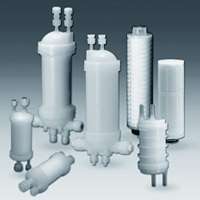



Selection Guide for Digital Printing Systems
Filtration Solutions for
Pall has designed specific filtration technologies for digital printing systems with performance and output quality in mind. |
Effective Dual-Filter Strategy
Although most ink jet inks are filtered well during formulation, filtration on-board a digital printer is necessary to capture any degradation byproducts, environmental contaminants, and residual printer component debris. The objective is to achieve optimal speed and quality of printer output over the long term.Filtration on-board a printer is most effective when two filters are used: a bulk filter followed by a last chance filter. The bulk filter has the capacity for high flow and retaining contaminants, and is commonly a self-contained, disposable capsule filter. The last chance filter is positioned very close to the ink jet printhead for point-ofuse filtration. Its purpose is to protect the printhead from contamination by debris, which can cause catastrophic failure.

Role of filter types on board an ink jet printer
Filter Requirements
When evaluating a filter, consider these basic requirements.- Flow rate. Higher flow rates necessitate larger effective filter areas (EFA).
- Long service life. A service life of at least three months is necessary. The high dirt-holding capacity of depth and pleated-depth filters extends service life, making them the best choices for filtering digital inks.
- Long-term chemical compatibility. The filter should be able to withstand exposure to the ink chemistry over time; media and capsule compatibility pressure boundary should remain intact.
- Pressure, temperature, and maximum exposure time. A filter capsule is a pressure vessel. It is important to take this into account when considering requirements for pressure, temperature, and maximum exposure time. Pressure and temperature, including any hydraulic or thermal cycling, must be well understood in order to select a filter capsule that is reliable and safe under the specified operating conditions.
- Serviceability. The type and orientation of the connections should facilitate quick filter changes with minimal mess.
Media Characteristics
To select the appropriate media, check for the following features.- Beta-rated. Beta-rated media provide higher removal efficiency and perform more consistently than nominally rated media. They have repeatable performance, which is ensured during manufacturing.
- Depth structure. Depth media and pleated-depth hybrid media generally have the most effective combination of cost savings, extended service life, and removal efficiency.
- Fixed-pore media. The media should be verified as nonshedding. Media migration can be catastrophic for an ink jet printhead.
- Gel retention. The media must be able to capture and retain gelatinous contaminants. This is a mandatory capability when using UV curable inks. Depth and hybrid media are preferred to ensure gel retention.
- High flow capacity. The ability of the filter media to handle high flow conditions is critical, especially in the case of solvent purge and high-speed printing.
- Low pressure loss. In the LCF application, low pressure loss is critical to prevent ink starvation and ensure proper printhead operation.
- Particle morphology. The morphology of various dispersion or colorant particles of similar chemistries is not necessarily the same. The media should be tested and evaluated for its long-term efficiency and service life with each dispersion or colorant type.
Relationship of Dispersion Profile to Filter Transmittance
The relationship of the ink dispersion profile to the filter transmittance is important in media selection. Filter media that is too coarse or that has an efficiency range that is too broad should not be used.
The graphs to the right illustrate the relationship of the dispersion profile and the filter transmittance for the following three conditions:
- Media is too coarse
- Media has an efficiency range that is too broad
- Media is optimal
Media is Too Coarse

Efficiency Range is Too Broad

Media is Optimal