



How can filtration support brewery sustainability programmes?
June, 2026
Breweries worldwide are adopting sustainability not only to reduce environmental impact but also to strengthen market position and brand value. From reducing water and energy consumption to minimizing waste and carbon emissions, brewers are rethinking every step of production. Pall supports this shift with advanced filtration technologies that help breweries progress environmental goals without compromising product quality.
Why does sustainability matter in brewing?
Sustainability is becoming a more important factor in consumer purchasing decisions, with growing expectations for brands to demonstrate environmental responsibility. In brewing, this means reducing resource use, improving energy efficiency and supporting clean water management while maintaining the taste and consistency customers expect.

How can breweries reduce water consumption?
Water is one of the most critical resources in brewing. The industry average ranges from 3 to 6 liters of water per liter of beer produced. Pall Aria™ Systems support high-quality water recovery and reuse, reducing freshwater demand and wastewater discharge. Breweries using Pall Aria™ Systems have achieved levels as low as 2.2 L/L.
Pall Aria™ FB Automatic Backwashable Water Filtration Systems provide an efficient water treatment approach for food and beverage operations and describe high water recovery, reduced operating costs and reliable process control.
How can breweries reduce DE waste in clarification?
Traditional beer clarification often relies on diatomaceous earth, or DE, which generates substantial waste. The Pall PROFi Membrane System replaces DE with membrane-based crossflow filtration, reducing waste by over 99%. In a 1 million hectoliter brewery, DE waste can be reduced from hundreds of tons to less than 300 kg per year while improving process control and safety.
PROFi Membrane System for beer clarification and Pall’s beer clarification materials position crossflow membrane filtration as a DE-free clarification solution that supports clarity, stability and operational efficiency.
How can stabilization help save resources?
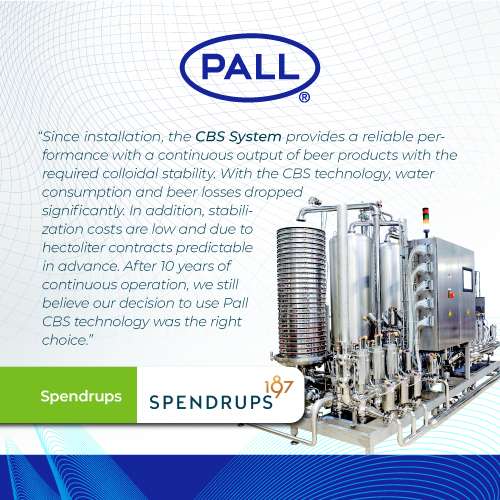
The CBS, or Continuous Beer Stabilization, System streamlines stabilization by using PVPP in a continuous loop. Compared with conventional methods, CBS reduces water and cleaning agent consumption by up to 30%. Smaller system vessels and automated cycling also lower labor and energy requirements while supporting sustainability and throughput.
Beer Stabilization and Colloidal Beer Stability describes the Pall CBS system as a flexible stabilization solution with compact design, lower water and energy consumption and improved operational efficiency.
How can breweries cut energy use in final filtration?
Pasteurization is energy intensive. The CFS NEO Cold Filtration System offers an alternative by using automated cartridge-based cold filtration rather than thermal treatment. This reduces thermal energy use by up to 72%, water consumption by 85% and power consumption by 80% compared with flash pasteurizers.
Beer Cold Filtration System - CFS NEO and the related Pall CFS NEO brochure present membrane-based cold filtration directly upstream of the filling line as a fully automated final filtration approach for beer.
What is the overall sustainability impact?
By integrating these technologies, breweries can reduce environmental footprint while improving product consistency and operational efficiency. Pall’s solutions are scalable and proven, helping brewers of different sizes meet regulatory requirements, enhance brand value and lower costs.
Contact a Pall expert to explore solutions suited to brewery operations.
Frequently Asked Questions
Why does sustainability matter in brewing?
Sustainability in brewing focuses on reducing resource use, improving energy efficiency and supporting clean water management while maintaining beer quality and consistency. Consumer expectations are also increasing around environmental responsibility.
How can filtration help reduce water use in breweries?
Filtration supports water management by enabling recovery and reuse within brewing operations. Pall Aria™ Systems support high-quality water recovery and reuse while reducing freshwater demand and wastewater discharge.
How can breweries reduce DE waste?
The Pall PROFi Membrane System replaces DE with membrane-based crossflow filtration. This approach reduces waste generation and supports more controlled clarification.
How can final filtration help reduce energy use?
The Pall CFS NEO Cold Filtration System uses membrane-based cold filtration instead of thermal treatment. This reduces thermal energy, water and power use compared with flash pasteurizers
Discuss brewery sustainability approaches with an expert
- Category
- Author
- Sort By