


What is condensate stabilization?
Condensate stabilization reduces the vapor pressure of liquid hydrocarbon condensate for safer transportation and storage. The process removes lighter hydrocarbons from natural gas condensate in a single stabilizer column or separates ethane, propane and butane in multiple fractionation columns.
Removing these volatile light ends produces stabilized condensate that is less susceptible to spark ignition. The separated products can also be used as petrochemical feedstocks. Effective removal of salty water and solids upstream helps protect the stabilizer column and reboiler from corrosion and fouling, supporting process efficiency and reliability.
Learn more about Pall's upstream condensate filtration and separation solutions.
What does a gas condensate stabilization plant need?
- Achieve or exceed condensate and lighter-product production quotas through reliable stabilization, fractionation and separation.
- Maintain consistent natural gas and condensate production while minimizing downtime and stabilizer-unit maintenance.
- Reduce the need for column and reboiler cleanouts and replacement of internal components.
- Maintain stable operation and consistent, on-spec sales condensate.
How can filtration improve condensate stabilizer reliability?
Salty water and fine particulate contaminants can form stable emulsions in condensate. Deposits and corrosion in stabilizer columns and reboilers can then contribute to process upsets, off-spec product, downtime and maintenance.
Removing liquid water and solids upstream of the stabilizer helps protect equipment from deposits, corrosion and related fouling. Pall absolute and nominal rated filter elements are available to reduce suspended solids to less than 5 ppmw. High-efficiency AquaSep® EL, AquaSep® XS and PhaseSep® EL liquid/liquid coalescers support clear and bright product specification and less than 20 ppmw downstream per Aqua-Glo measurement, helping maximize salt and water removal.
| Condensate production challenge | Pall filtration approach |
|---|---|
| Fine corrosion products may not be adequately removed by filters affected by poor removal performance, unloading, media migration, channeling or poor sealing. | Use effective solid-particle filtration before liquid/liquid coalescing to reduce suspended solids, protect the coalescer and keep downstream process equipment cleaner. |
| Salty water and particulate contaminants can contribute to deposits, brine-initiated corrosion, fouling and process upsets. | Use high-efficiency liquid/liquid coalescers upstream of the stabilizer to maximize salt and water removal and protect the stabilizer column and reboiler. |
How does the condensate stabilization process work?
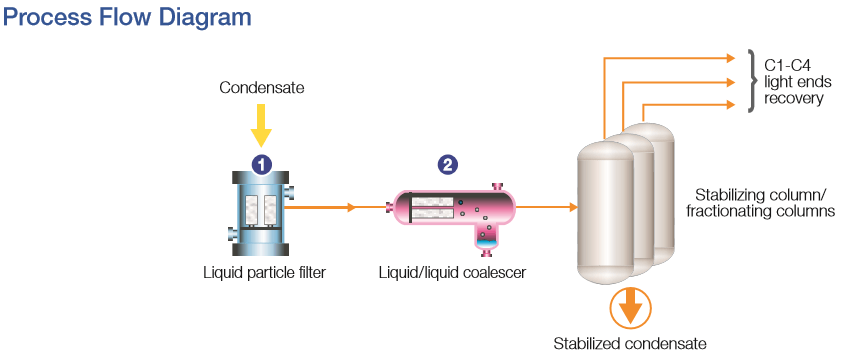
Condensate first passes through a liquid particle filter to remove fine solids. A liquid/liquid coalescer then removes entrained water before the condensate enters the stabilizing or fractionating columns. The columns remove C1-C4 light ends and recover stabilized condensate.
See Liquid/Liquid Coalescing in Action
Learn how liquid/liquid coalescers remove entrained water from hydrocarbon streams to help protect downstream stabilizer columns and process equipment.

Liquid/Liquid Coalescers - Liquid Separation and Particle Removal
Which Pall filters and coalescers support condensate stabilization?
| Application | Recommended Pall products | Customer benefit |
|---|---|---|
| Prefiltration before the liquid/liquid coalescer | Ultipleat® High Flow filters; Ultipleat High Flow HT filters; Profile Coreless filters; Marksman™ filters | Support longer coalescer life and reduce particulate fouling of stabilizer columns. |
| Stabilizer column protection | AquaSep XS; AquaSep EL; PhaseSep EL liquid/liquid coalescers | Support safe, reliable hydrocarbon-liquid production by protecting stabilizer columns from brine-initiated corrosion and fouling. |
See condensate stabilizer protection in practice
Read how Pall PhaseSep coalescers have been used to protect condensate stabilizers.
Need a faster filtration or coalescer upgrade?
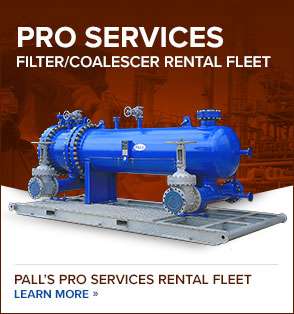
Pall replacement filters and coalescer retrofits provide a route to Pall filtration quality without changing the existing filter housing. Pall filter and coalescer housing rentals can support a technology upgrade for rapid problem resolution.
Experience Matters
Pall has more than 50 years of experience supporting filtration and separation processes. Our filtration and coalescing technologies help protect critical process equipment while supporting reliable operation and consistent output.
Frequently asked questions
What is condensate stabilization?
Condensate stabilization reduces the vapor pressure of liquid hydrocarbon condensate by removing volatile light hydrocarbons. This supports safer transportation and storage and produces stabilized condensate.
How does a condensate stabilizer work?
Natural gas condensate enters a stabilizer column where C1-C4 light hydrocarbons are removed. Fractionation can also separate ethane, propane and butane in multiple columns.
Why remove water and solids before a condensate stabilizer?
Salty water and fine solids can contribute to deposits, corrosion and fouling in stabilizer columns and reboilers. Upstream filtration and liquid/liquid coalescing help protect equipment and support reliable operation.
What filtration is used before a liquid/liquid coalescer?
Ultipleat High Flow, Ultipleat High Flow HT, Profile Coreless and Marksman filters can be used for prefiltration to protect the coalescer and reduce particulate fouling of stabilizer columns.
What is the difference between stabilized and unstabilized condensate?
Stabilized condensate has had volatile light ends removed. This lowers vapor pressure and makes the condensate less susceptible to spark ignition during transportation and storage.
How can stabilizer column fouling be reduced?
Stabilizer column fouling can be reduced by removing solids and entrained water upstream of the column. Effective filtration and liquid/liquid coalescing help limit deposits, corrosion and process disruptions caused by contaminants in the condensate feed.
Improve Condensate Stabilization Reliability